CRI: what does it show us, or not show us?

Future meets past, how to interpret the CRI value with contemporary light sources

CRI stands for Color Rendering Index, or color representation index. The methodology allows the researcher to quantitatively determine the color representation of light. Simply put, what light color/wavelengths are present in the light.
However, there are a lot of limitations regarding the use of CRI and LED. But also when using CRI, for light sources, under a CCT of 5000 Kelvin. In principle, how the spectrum relates to its position on Blackbody Locus should always coincide with the CRI value.
Whereas applying CRI with heat emitters gave a pretty good indication of light quality, this is absolutely not true with LED.

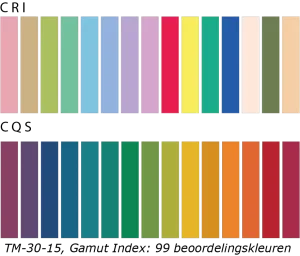
It is relatively easy for an LED to score a high CRI but have poor color fidelity. CRI by itself says nothing about light quality when applied to an LED light source. At most, it gives an indication. This is a well-known problem and led to the development of CQS: Color Quality Scale. Whereas CRI measures mainly pastel-like colors, CQS assigns a greater value to full color saturation.

CRI en CQS-waarde
The colors measured with CQS are more saturated and thus give a better representation of light quality. However, without consulting the Blackbody Locus, CQS also stands alone

LED and CRI: is CQS or IES TM-30-15 more appropriate?

CRI and LED do not go together to determine the light quality of a light source. Yet CRI is still frequently displayed on lamp packaging. LED manufacturers also still default to the CRI value in its data sheets. Whereby reputable LED manufacturers give clear binnings in which area the LED is located on the Blackbody Locus. Combined, it gives a good prediction of the light quality of the light source.

To measure light quality with LED, the CQS value gives a better reflection because color saturation plays a greater role. In short, this means that by definition the spectrum should be richer than if measured only on the pastel colors of the CRI scale.

Combined with the Blackbody Locus, CQS gives a pretty good predictability of light quality

IES TM-30-15

The superlative of CQS, limited to 15 assessment colors vs. CRI’s 8, TM30-15 puts 99 assessment colors to the test. These assessment colors are subjected to a test that then gives 3 outcomes: Fidelity Index, Gamut Index and Color Vector Graphic.
The results of TM30-15 provide a good picture of light quality due to the comprehensive test parameters and visual representation of the results.

The Fidelity Index (Rf) measures how close the color actually is to the reference color measured. Based on a score of 0 to 100, assessment colors are measured. The Fidelity Index is divided into 7 main groups in order to easily see how the light source performs for the set areas.

The Gamut Index (Rg) represents the purity of the assessment color. That is, to what extent the assessment color saturates. In practice, this value tells us the extent to which the artificial light is able to represent saturated colors. A tomato, under a limited amount of qualitative red-light saturation, will show less contrast. And thus leave a less fresh impression. The Gamut Index is measured on a scale of 0-120. Where scores above 100 represent an oversaturation of the assessment colors.

The Color Vector Graphic easily displays in an intuitive graphical overview how different colors perform in terms of color saturation.

The black border shows the representation of sunlight of a certain color temperature

The Blackbody Locus is of less importance with the TM30-15 methodology because there is also room for oversaturation in the test results. Compared to CRI, TM30-15 is definitely recommended to use when light quality is of great importance.

Blackbody Locus/the Planckian Locus

In 1900, scientist Max Planck came up with a methodology to measure the electromagnetic radiation from a “black body. A black body is a component that does not reflect radiation. With that, all the radiation it emits comes from the black body. Max Planck used the Kelvin scale to measure radiation at different temperatures. He found that at 300 Kelvin the radiation was infrared, the higher the temperature the more shorter wavelengths were emitted (such as UV radiation and X-rays).
In lighting technology, Kelvin is used to indicate color temperature. This means a certain spectral ratio at which a certain temperature was measured at the time.

Both theoretically or actually through observation. During the observation, there was a distinct change from red to bright blue as the temperature increased. The corresponding visible light was measured and then applied as a guide to determine certain light color regions, referring to the spectrum. These tests led to then possible answer to the UV Catastrophe[1].

[1] https://en.wikipedia.org/wiki/Ultraviolet_catastrophe

These areas graphically deposited led to the Blackbody Locus or the Planckian Locus. Combined with CRI, the position of the measured spectrum tells us something about the saturation of certain colors and the balance between them (wavelengths).

Want to know more about light and light quality? Read our blog post on lighting quality

Check out ClearLED’s high-quality light sources